The 5 Hidden Signs of Burnout That High-Achieving Women Miss - and What to Do About Each One
Aug 03, 2026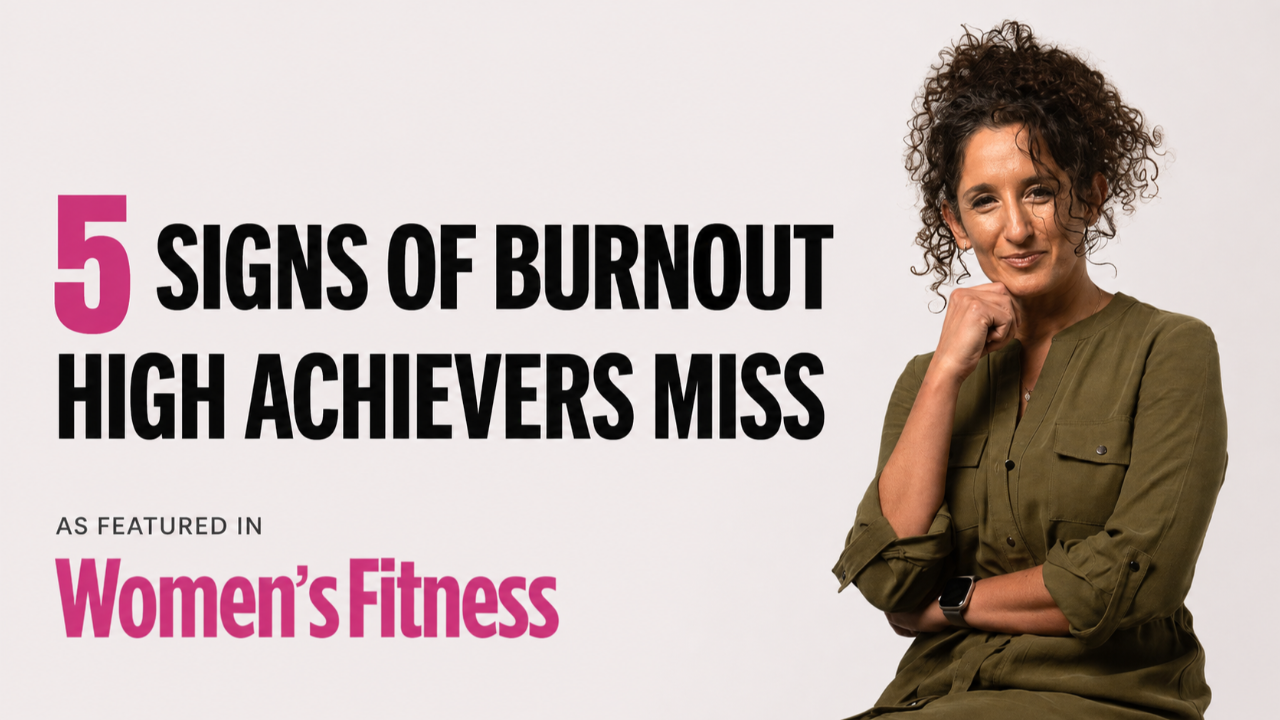
Burnout does not announce itself - particularly in high-achieving women who are conditioned to push through, normalise exhaustion, and mistake chronic depletion for simply being busy. The common myth is that burnout happens because you work too hard. The harder truth is that burnout is primarily driven by emotional overload - by consistently failing to honour your own needs, boundaries, and identity while pouring energy into everyone and everything else around you. In this expert feature for Women's Fitness Magazine, Dr Rana Al-Falaki identifies the five hidden warning signs that high performers consistently miss, and why recognising them early is the difference between course-correcting and burning out completely.
THE 5 HIDDEN SIGNS - AND WHAT TO DO ABOUT EACH ONE
1. Physical Cues You Are Normalising
High-achieving women are particularly skilled at brushing away physical symptoms - attributing brain fog, fatigue, and weight changes to hormones, a busy season, or simply the reality of juggling everything. But when fatigue is felt deep within the body and a good night's sleep makes no difference, that is not tiredness - that is your nervous system sending a serious signal. Chronic stress elevates cortisol, which impairs muscle recovery, disrupts sleep quality, lowers immunity, and drives inflammation throughout the body.
Take action: Conduct a daily energy check-in using the IMERSE model - Identity, Mental, Emotional, Real (physical), Social and Environmental influences. Ask yourself: have I drunk enough today? Have I eaten well? Have I moved my body? Have I listened to what my body is telling me? If any answer is no, act on it immediately rather than filing it away for later.
2. Emotional Detachment
A classic sign of advanced burnout - and one that is frequently missed - is emotional detachment. This is the freeze stress response: the amygdala, perceiving chronic threat, eventually shifts from fight or flight into shutdown mode. You may notice reduced empathy, a sense of going through the motions, difficulty accessing joy even in things that once lit you up, and a robotic quality to your interactions. For someone who has always been the supportive friend, the engaged leader, or the present parent, this shift can trigger guilt that deepens the spiral further.
Take action: Choose five moments throughout the day - including first thing in the morning and last thing at night - to pause and ask yourself three questions: how am I feeling right now? How do I want to feel? What is one small thing I can do to move towards that? Simple emotional regulation tools - journalling gratitude, up-regulating breathwork, going outside, or even listening to a song that once made you happy - are not indulgences. They are performance strategies.
3. Addiction to Achievement
High achievers are, by definition, wired to achieve, and every win releases dopamine and endorphins that reinforce the drive to keep going. The problem arises when achieving stops feeling like a choice and starts feeling compulsory: when rest triggers guilt, when injury does not stop training, when the next goal is already being chased before the current one is celebrated. Dr Rana Al-Falaki calls this being a "wantaholic" and describes herself as a recovered one.
The distinction between a healthy goal and an addictive tendency is this: a healthy goal feels energising and allows for patience when progress is slower than expected. An addictive tendency feels compulsory, generates guilt and self-criticism when the pace falters, and is fundamentally driven by a need for external validation rather than internal fulfilment.
Take action: Set clear, conscious boundaries around what is necessary for success - and find someone to role model who achieves at a high level without overdoing it. Draw a firm line between what is healthy and what is driven by compulsion, and hold it.
4. Losing Joy and the Ability to Rest
When cortisol is chronically elevated, dopamine receptors down-regulate - meaning that even when your body produces dopamine, you no longer feel its effects. Joy becomes blunted. The brain's reward system shifts from pleasure-seeking into pure survival mode. The hippocampus reduces in volume, impacting memory, mood, and your sense of pleasure. Systemic inflammation further dampens enthusiasm and motivation. High achievers typically miss this sign because they continue to function - hitting deadlines, managing responsibilities, maintaining routines , while feeling increasingly hollow inside. The logical brain simply tells them they are fine, just busy.
Take action: Practise a structured gratitude exercise daily. Write three things you are grateful for across four areas -your physical self, your relationships, your career, and the life you are building. Then speak them out loud, three times each, in front of a mirror. It takes under a minute and directly stimulates the neuro-chemical pathways that burnout suppresses.
5. Isolation
High achievers are already primed for isolation - their dopamine comes from succeeding, which means relationships, socialising, and rest naturally fall lower in the priority order. When burnout sets in, isolation accelerates: there is shame about no longer performing at previous levels, fear of being judged as weak, exhaustion that makes conversation feel like effort, and a nervous system in shutdown mode that conserves every available unit of energy. The painful irony is that isolation is one of the most powerful accelerants of burnout - yet it feels, in the moment, like the only option.
Take action: Identify three people you trust and ask them to check in with you daily on a rota basis. Set the expectation clearly - you may only respond with a word or two, and that is enough. Commit to meeting one of those people in person at least once a week. Treat it as a non-negotiable goal, with the same discipline you apply to everything else.
Burnout in high-achieving women rarely looks like collapse. It looks like pushing harder, achieving less, and feeling increasingly disconnected from the life you worked so hard to build. The NAIL-IT Leadership system was developed precisely to close that gap - providing professionals with the framework, tools, and self-awareness to perform at their highest level without the personal cost. If any of these five signs resonated, do not wait for the full picture to arrive. The earlier you act, the faster you recover - and the stronger you return.